


When Plastic Entered the Home: Moplen and the 1960s
3 Feb 2026Curiosity

In the previous chapter of the history of plastic, we talked about Bakelite — the dark, durable plastic that became a symbol of industry and technology in the early decades of the twentieth century. But the real turning point, the one that brought plastic into homes, kitchens, and everyday life for millions of people, came a few decades later.
We are in the post-war period, and the world is changing fast.
The Economic Boom: Plastic Becomes Everyday
Between the 1950s and 1960s, Europe — and Italy in particular — experienced a phase of strong economic growth. Families began purchasing more goods, and homes filled with new, practical, modern objects.
It is in this context that a plastic destined to become iconic made its appearance: isotactic polypropylene, better known by its commercial name Moplen.
Moplen was developed in the early 1950s by Italian chemist Giulio Natta, who received the Nobel Prize in Chemistry in 1963 for his research on polymers. Compared to earlier plastics, this material had properties perfectly suited for household products: it is lightweight, durable, easy to mold, inexpensive, and suitable for food contact. In short, it was ideal for the new post-war lifestyle.
Thanks to Moplen, washbasins, colanders, containers, chairs, tableware, and other simple yet functional household items spread widely. Often colorful and designed to last, these products were accessible to everyone. Plastic ceased to be just a technical or industrial material and became part of daily domestic life.
This was also a cultural shift. For the first time, “non-traditional” materials replaced wood, glass, or metal — not because they were more “noble,” but because they were more practical. And practicality, during the economic boom years, was a core value.
Color, Optimism, and the Power of Advertising
What truly made Moplen famous was communication. In the 1960s, television entered Italian homes on a large scale, bringing with it a new way of advertising. The emblematic program of this era was Carosello.
It was during Carosello that one of the most famous slogans in Italian advertising history aired: “E mò? E mò, Moplen!” Plastic was no longer presented as a technical innovation, but as a smart, modern, almost inevitable choice. Commercials were short, ironic, often featuring recurring characters and everyday situations. The message was clear: these products made life easier.
For the first time, a material became the protagonist of advertising storytelling, entering the collective imagination and becoming associated with the idea of domestic progress. Plastic fit perfectly into an optimistic era that looked to the future with confidence. It was not yet seen as an environmental issue, but as a solution — hygienic, durable, and democratic.
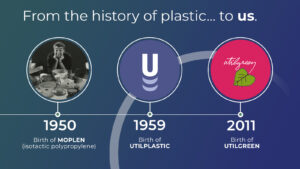
The history of Utilplastic is also connected to that period and to the development of Moplen: the company took its first steps back in 1959.
Looking Back from Today
Looking back at that era today means holding two perspectives together. On one hand, recognizing the important role materials like Moplen played in making everyday objects more practical. On the other, acknowledging that the intensive use of traditional plastics revealed its limits and consequences only over time.
History, however, is not static. Materials evolve alongside the societies that use them, and plastic has also begun to change. New technologies and a growing focus on environmental impact have opened alternative paths compared to those of the economic boom years.
Building on its long history, Utilplastic is now moving in this direction as well — particularly with the Utilgreen line (household products made from post-consumer recycled plastic) and with its first biodegradable plastic utensils. Small but concrete steps that reflect a different way of looking at the same material.