


Utilgreen: Utilplastic household products with a green heart
12 Mar 2026Productions

Is it possible to produce durable household tools starting from plastic that has already been used? This is one of the many questions we at Utilplastic have asked ourselves over the years. The answer we found is: yes, it is possible. However, turning this idea into reality requires work, research, experimentation, and clear choices, exactly what we have done.
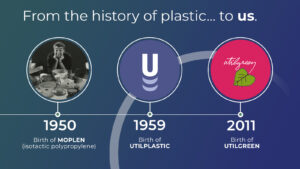
From this perseverance came our “green-hearted” household product line, Utilgreen, which this year celebrates its 15th anniversary. Since 2011, Utilgreen has allowed us to make the most of the experience gained over years of plastic processing, contributing actively to a more conscious and environmentally responsible production. It is not a marketing exercise, but an industrial project that starts with a change in raw materials.
A plastic that has already lived
It’s easy to say “recycled plastic”! Even in this field, there are important differences. To produce Utilgreen items, we start with a specific material: post-consumer plastics. These are plastic materials coming from the separate collection of household waste, which means they have already had a first life. Using them helps reduce waste, limit the use of new resources, and save energy compared to producing virgin plastic.
Of course, choosing post-consumer plastics rather than industrial plastic scraps presents several challenges. The first is the nature of the material obtained from the recycling process: plasmix. Unlike recycled industrial plastic, plasmix is not homogeneous. Instead, it is a blend of different plastics that must be homogenized before it can be reused.
For a long time it was very difficult, if not impossible, to reprocess and enhance plasmix. Utilplastic was among the first companies to invest time and resources in this direction in order to find the right compound. Like true pioneers, we conducted feasibility studies and tests together with university laboratories and with the support of public and private organizations.The result arrived in 2011 with the creation of our first container made from post-consumer recycled plastic.
This product officially marked the beginning of Utilgreen. Years of research and experimentation were not wasted, and over time the sector of recycled plastic compounds has made enormous progress. Today, thanks to advanced technologies and expertise, plasmix can be transformed much more easily into solid and functional objects.
A choice you see (and don’t see)
Utilgreen household products range from bins and buckets to planters, brooms, dustpans, and toilet brush holders. Their mechanical strength and durability are the same as household items made from virgin plastic: the difference is not visible. Yet, in a certain way, it still shows.
Utilgreen products do not come in bright colors or glossy finishes. This “signature look” reflects their more sustainable origin. Plasmix does not allow vibrant coloring, so the products are mostly dark, black or grey, with a simple and understated appearance.
Their value does not lie in striking aesthetics, but in what they represent and the material they are made from. Every object tells a story of recovery and transformation, made possible by everyday actions such as separate waste collection — small gestures that become part of a larger circular cycle.
Looking ahead, starting from what already exists
Research does not stop here. Alongside recycled plastic, we have also begun experimenting with alternative materials. One example is our first brush made from bioplastic, another step toward new solutions and possibilities.
Biodegradable plastics originate from biological and organic sources, which are then transformed into polymers with properties similar to traditional plastic, but capable of decomposing in a cleaner way.
Utilgreen therefore proudly celebrates its 15th anniversary, carrying with it the milestones achieved so far and the challenges ahead. The goal is not to eliminate plastic, but to use it more intelligently. Recovering, transforming, and giving new value to what already exists, while investing in research to find less impactful yet high-quality solutions: this is the direction we are taking.
Because materials, like companies and people, can change their path and continue to evolve.